On this page, you’ll find information about the reporting format and fee model you will encounter when your producer responsibility takes effect on 1 October 2025.
Note: Status of fees
The eco-modulated fee rates are still under review. They will be updated on the Prices page as soon as they are available.
Effective from 1 October 2025
| Single-use packaging | Single-use packaging with individual take-back scheme | Reusable packaging with individual take-back scheme* | |
| Reporting (over 8 tonnes annually) | Monthly reporting from the 1st–15th of each month. (First reporting period: 1–15 November 2025 ) |
Not yet decided – update to follow | Not yet decided – update to follow |
| Reporting (under 8 tonnes annually) | Quarterly reporting: Q1: 1–15 April Q2: 1–15 July Q3: 1–15 October Q4: 1–15 January (First reporting period: 1–15 January 2026 ) |
Not yet decided – update to follow | Not yet decided – update to follow |
| Invoicing | Issued when the reporting period closes for the given month. 30-day payment term from invoice date | 30-day payment term from invoice date | 30-day payment term from invoice date |
| If payment is not received on time | Not yet decided – update to follow |
*Mandatory
The tables below show what you need to report to Emballageretur.
This includes material categories, levels of modulation, whether the end user disposes of the packaging as business waste or household waste, and whether the waste must be sorted as residual waste, hazardous waste, or general waste*.
*General waste means that the packaging can be sorted as, for example, cardboard or plastic, because it is designed for recycling.
Quantities placed on the Danish market – applies to both single-use and reusable packaging.
| Material category | Green level (kg placed on the market) | Yellow level (kg placed on the market) | Red level (kg placed on the market) | ||||||
|---|---|---|---|---|---|---|---|---|---|
| RESIDUAL | HAZARDOUS | GENERAL | RESIDUAL | HAZARDOUS | GENERAL | RESIDUAL | HAZARDOUS | GENERAL | |
| Rigid plastic | |||||||||
| Flexible plastic | |||||||||
| Foam plastic | |||||||||
| Rigid PET | |||||||||
| Food and beverage cartons | |||||||||
| Material category | Green level (kg placed on the market) | Red level (kg placed on the market) | ||||
|---|---|---|---|---|---|---|
| RESIDUAL | HAZARDOUS | GENERAL | RESIDUAL | HAZARDOUS | GENERAL | |
| Glass | ||||||
| Cardboard | ||||||
| Paper | ||||||
| Ferrous metals | ||||||
| Aluminium | ||||||
| Material category | Quantities placed on the market (kg) | ||
|---|---|---|---|
| RESIDUAL | HAZARDOUS | GENERAL | |
| Wood | |||
| Textile | |||
| Cork | |||
| Ceramics | |||
| Other | |||
| Material category | Quantities placed on the market (kg) |
|---|---|
| Household packaging | |
| Commercial packaging |
Packaging that is not reusable packaging
Packaging that has been designed, conceived, and placed on the market with the intention of being refilled or reused for the same purpose during its lifecycle.
Packaging where a household is likely to be the end user.
Packaging that is not household packaging.
The supply of packaging or filled packaging for distribution, consumption, or use on the Danish market as part of a commercial activity, whether for payment or free of charge.
Packaging that, after use, must be sorted as residual waste.
Packaging that, after use, must be sorted as hazardous waste.
Packaging that, after use, must be sorted into the relevant recycling fraction.
The material category refers to the classification to which a packaging unit or any separate components belong.
The material category of the packaging is determined according to Annex 14 of the Danish Packaging Executive Order (Emballagebekendtgørelsen).
The Danish Environmental Protection Agency has also published additional guidance on how to categorise packaging: Guidance on Eco-Modulation (Vejledning til miljøgraduering).
Soft plastic, rigid plastic, foam plastic, rigid PET, and food and beverage cartons:
Cardboard, paper, ferrous metals, glass, and aluminium:
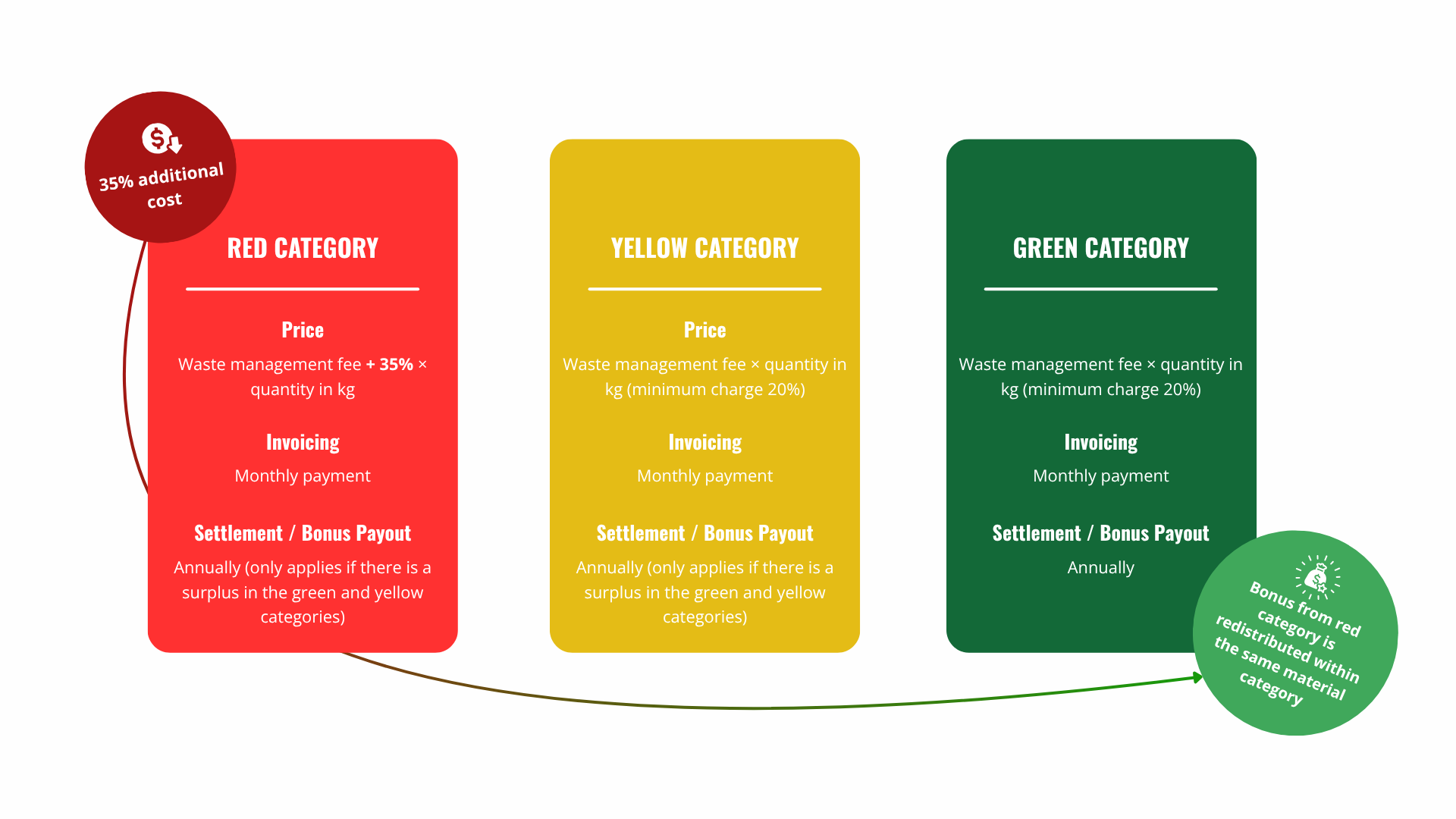
Red level: +35% of the operational waste management costs
Green level: Operational waste management costs
OBS: Indberetning i grønt/gult niveau forudsætter rette dokumentation. Beskrivelse for dokumentation findes i Emballagereturs egenkontrol.
Annual calculation: Once a year, the additional 35% fees paid for red-level packaging are calculated separately for each material category.
Calculation process: Takes place after the annual reporting to DPA, including any corrections such as quantity adjustments, re-exported packaging, reporting errors, etc. Deadline: 31 May each year.
Redistribution: Follows the calculation method set out in the Executive Order.
First payout: In Q3 2026, covering October, November, and December 2025.
Producers placing less than 8 tonnes of packaging on the market annually
Inner packaging as defined in Article 1(23) of Directive 2001/83/EC and Article 4(25) of Regulation (EU) 2019/6
Primary packaging for medical devices as defined in Regulation (EU) 2017/745
Primary packaging for in vitro diagnostic medical devices as defined in Regulation (EU) 2017/746
Outer packaging as defined in Article 1(24) of Directive 2001/83/EC and Article 4(26) of Regulation (EU) 2019/6, where the packaging is necessary to preserve the quality of the medicinal product
Primary packaging for infant formula and follow-on formula, processed cereal-based foods and baby food, and foods for special medical purposes as defined in Article 1(a), (b), and (c) of Regulation (EU) No 609/2013
AProducer Responsibility Organisatio (PRO) must apply eco-modulation to a producer’s financial contribution, in accordance with section 2 or 3, if the producer requests it.
Under the producer responsibility for packaging, it is legally required for collective schemes to apply eco-modulated fees. The eco-modulation model is set out in the Danish Packaging Executive Order and consists of two main parts:
A system of material subcategories, modulation levels, and design criteria that determine which level your packaging falls into.
A financial model that defines how much you, as a producer, must pay based on the classification of your marketed quantities.

Producers must cover the operational costs associated with the handling of their packaging waste.

The total contributions collected may not exceed the total operational costs related to the management and treatment of packaging waste.

In other words, producers collectively pay 100% of the costs, but the contributions are redistributed according to the recyclability of the packaging.
Eco-modulated fees are payments that reflect how environmentally harmful a type of packaging is. The purpose of the eco-modulated fee is to give producers a financial incentive to design packaging that is easier to recycle, thereby promoting a more circular economy.
The harder a packaging material is to recycle – for example, if it is made from mixed materials – the higher the fee.
Producers who choose less environmentally harmful solutions (green level) may have part of their costs covered through the additional fees paid by producers using red-level packaging (high environmental impact).
It is important to emphasise that eco-modulated fees are mandatory by law. The collective schemes, including Emballageretur, have been appointed to manage the administration of the eco-modulated fees – including the categorisation – but we have no influence over the criteria or the financial framework set by law.
 Emballageretur