Producer Responsibility for Packaging Takes Effect on 1 October 2025. This means that the time is approaching for the first payments to be made.
On this page, you can get an overview of the charges that apply as part of your producer responsibility for packaging.
The producer responsibility for packaging applies to packaging that ends up as either household waste or business waste. Therefore, you will find the prices for both household packaging and business packaging on this page. You will also find information about the compensation rates for business packaging waste available to waste-generating companies.
For business packaging, producer responsibility entails a financial obligation. This means that companies generating waste can apply for compensation to cover the costs of collecting, transporting, and treating business packaging waste generated at their physical location.
In practice, the waste-generating company must apply for compensation from the collective scheme assigned to the municipality where the company is physically located and registered with a P-number.
Please note: The collective scheme you are a member of is not necessarily the same as the one from which you must apply for business packaging compensation.
See the allocation of municipalities for business packaging compensation here (link to PDF list?).
For packaging that ends up as household waste — that is, waste generated by consumers — you, as the producer, have financial, organisational, and legal responsibility.
This means that you are:
– Financially liable for the packaging waste based on material category and weight in kilograms
– Responsible for organising the handling and treatment of packaging waste once it is handed over by municipalities after collection from households
– Legally responsible for the entire life cycle of the packaging waste, including requirements for high recycling quality and meeting recycling targets
Click to go to a category:
Please note: As a producer, you will also receive invoices from other entities such as the DPA and the Danish Environmental Protection Agency (Miljøstyrelsen). These invoices are not issued by Emballageretur or Retur and are therefore not included in this overview.
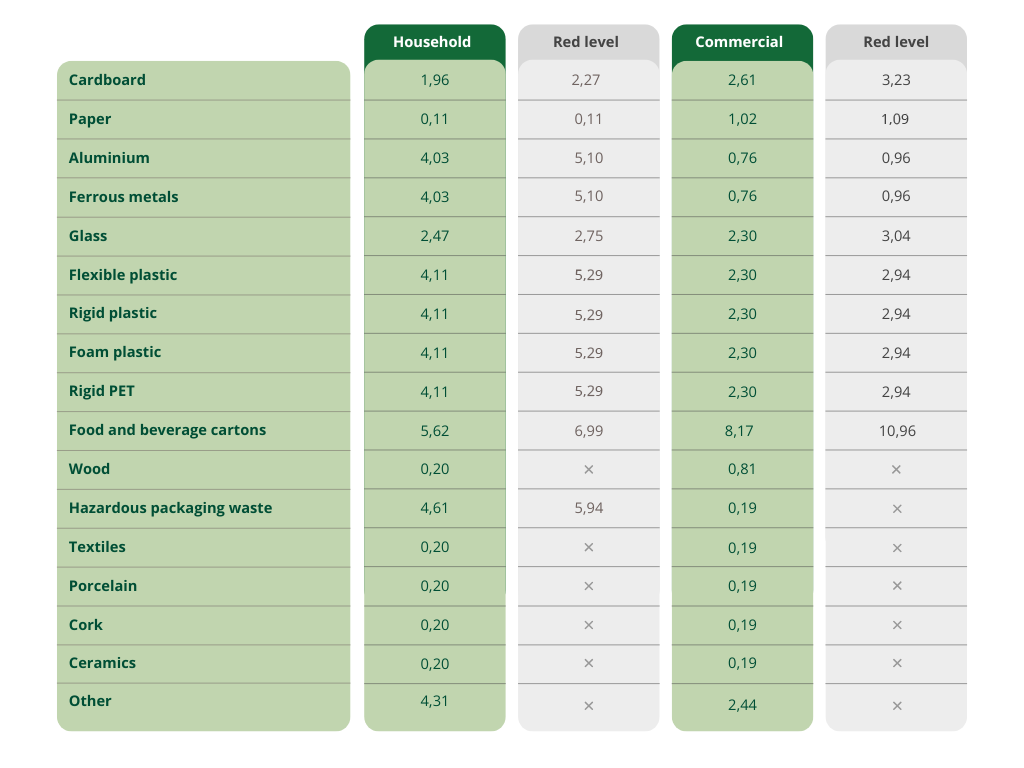
Prices apply from 1 October – 31 December 2025 and are exclusive of VAT.


Other Plastics
This material subcategory includes all types of packaging that do not fall under soft or rigid plastic categories. This includes packaging made from various types of foam plastic, often used for transport protection or insulation — e.g. EPS (expanded polystyrene), XPS (extruded polystyrene), EPP (expanded polypropylene), PUR (polyurethane), and similar materials.
|
Environmental Fee |
The environmental fee is the basic contribution you, as a member, must pay for the handling of your packaging waste within the given material category at the green or yellow level, when the packaging ends up as general or residual waste. The fee covers the operational and administrative costs associated with fulfilling your producer responsibility obligations. |
|
Eco-Modulated Fee |
The eco-modulated fee is the price you, as a member, must pay for the handling of your packaging waste when placing packaging on the market that falls under the red level. The eco-modulated fee adds 35% to the operational costs. Any member who cannot provide documentation proving that their packaging belongs to the green or yellow level will be charged the rate for the red level. |
|
Administrative Fee – Reusable and Take-Back Scheme Packaging |
If you use reusable packaging and/or single-use packaging covered by your own take-back scheme, you will be charged an administrative fee based on the volumes placed on the market. This fee covers costs incurred by Emballageretur related to reporting your data, system operations, service, expertise, and guidance. |
|
Administrative Fee – Cork, Textiles, Ceramics, and Other |
These material categories are subject to administration only, as they are not assigned any financial obligations for either household or business waste. The administrative fee covers costs incurred by Emballageretur for data reporting, system operations, service, expertise, and guidance. |
|
Hazardous Waste – Business |
Hazardous business waste is currently not included in the scope of producer responsibility, and is therefore not listed in the price list. |
|
Hazardous Waste – Household |
There is a single unified price across materials, as municipalities apply a fixed fee for the handling of hazardous waste. This means that the hazardous waste category may appear “cheaper” than pure material categories — however, this is not the case, as the fee is a so-called flat fee. A flat fee means you pay a fixed amount for a service or product — in this case, regardless of whether the material would otherwise be more or less expensive by origin. |
|
Reusable Packaging |
As a general rule, you do not have to pay your collective scheme for the handling of reusable packaging placed on the market, since you are required to organise your own take-back when the packaging becomes waste. When the price list also includes reusable packaging, this refers to the price that must be paid if there is a discrepancy between the amount marketed and the amount taken back — i.e., where the packaging waste is assumed to have ended up in established waste systems such as recycling stations, or disposed of by companies or consumers. |
|
Soft Plastics |
This material subcategory includes packaging made predominantly of soft plastics, flexible films, laminates, multilayer materials, and flexible plastics. Soft plastic may consist of a single plastic type or be a composite of various materials such as polyethylene (PE), polypropylene (PP), polyethylene terephthalate (PET), nylon (PA), fibre-based materials, and aluminium. |
|
Hard Plastics |
This material subcategory includes packaging made of all types of rigid plastics, such as polyethylene, polypropylene, polystyrene, and rigid polyethylene terephthalate (PET). Rigid plastic may be made from a single material type or a composite of several types. |
|
Foam plastic |
Includes packaging made from all types of foam plastic, for example for transport protection or insulation, e.g. EPS (expanded polystyrene), XPS (extruded polystyrene), EPP (expanded polypropylene), PUR (polyurethane) and similar materials. For foam plastic, the dominant material is foam plastic, but the packaging can be composed of different materials. |
|
Rigid PET |
Includes rigid PET (polyethylene terephthalate) packaging, as distinct from flexible PET, which falls under the flexible plastic material category. For rigid PET, the dominant material is rigid PET, but the packaging can be composed of different materials. |
The membership fee partially covers the administrative services that Emballageretur provides on behalf of its members. These services include member support and guidance, communication, data management, financial and contract administration, and more.
The fee is DKK 1,500 per year per member.
Regardless of whether you are a member of one or more of Retur’s collective schemes (Elretur, Emballageretur, Batteriretur, or Fiskeriretur), you only pay DKK 1,500 per year.
The membership fee for Emballageretur is invoiced once a year. In May/June 2025, the fee has already been invoiced to companies that are members of Emballageretur and one or more of our other collective schemes, such as Elretur or Batteriretur.
Companies that are only members of Emballageretur will receive the 2025 membership fee invoice at the beginning of October.
From 2026 onwards, invoicing will be consolidated so that all members — regardless of which schemes they participate in — will receive their membership fee invoice in May/June.
The membership fee is invoiced by Retur (CVR no.: 44513498). This is because Retur has chosen to provide administrative services jointly for all of our collective schemes, to ensure efficient processes and reduce costs for our members. Therefore, your annual membership fee invoice will come from Retur.
From 1 October 2025, the Danish PROs – including Emballageretur – will be responsible for managing and financing the amount of packaging waste their members place on the Danish market.
From the outset, the PROs are legally required to cover a number of mandatory expenses on behalf of their members – including payments to municipalities, which have indicated that their costs must be paid in advance.
To meet these obligations, we will issue invoices in August and November 2025 for an advance payment that covers your company’s proportional share of the expected start-up costs.
No. The advance contribution covers the same costs that will later be financed through the environmental contribution, but is invoiced earlier because some expenses must be paid in advance from the start.
It is therefore not an extra cost, but an advance payment which you will be reimbursed.
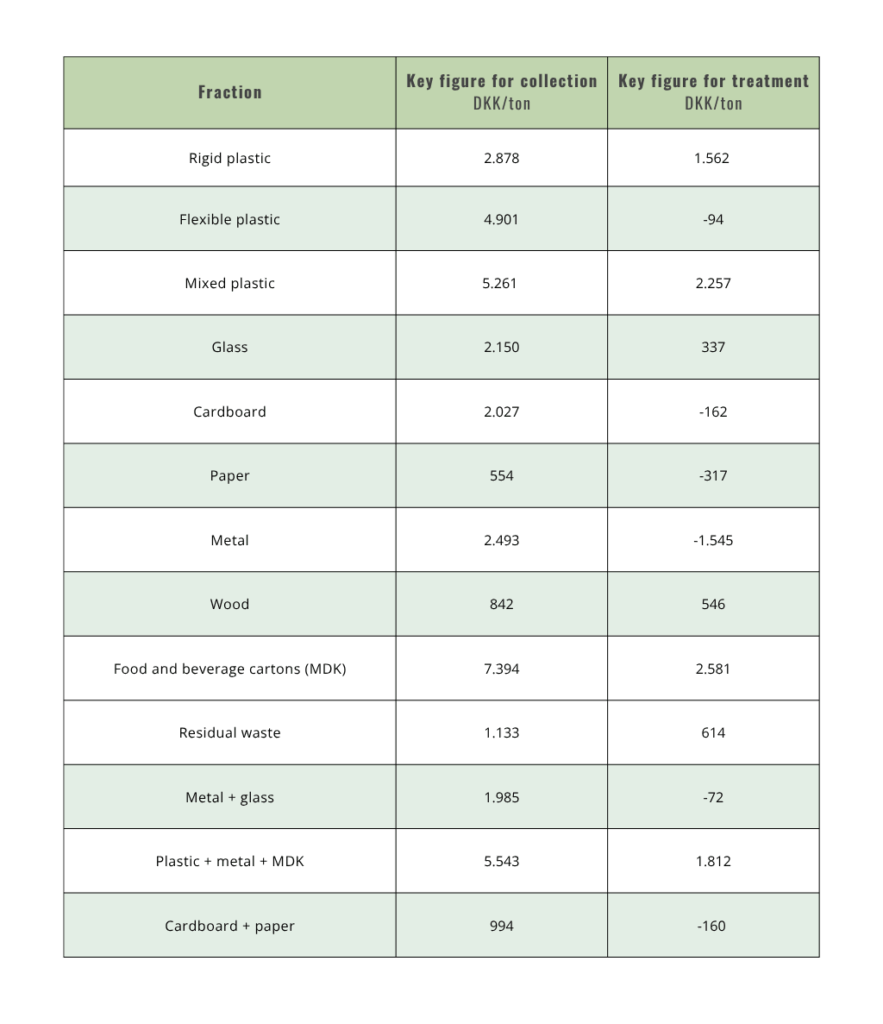
The compensation rates for business packaging are set by the authorities. Based on these key figures, the collective schemes must calculate the compensation that waste-generating companies are entitled to receive.
Compensation can be applied for starting from the date the producer responsibility takes effect: 1 October 2025.
Applications for payment may cover a continuous period of up to 3 months, but must be submitted no later than 12 months after the waste has been treated.
All PROs have now published their prices, which naturally leads to many comparisons across the market.
At Emballageretur, we are proud to offer low and competitive prices to our members. However, it is also important to point out that prices among PROs cannot always be compared directly.
Most PROs have a collection responsibility. This means that they – based on their market share – are assigned one or more geographical areas in Denmark where they must collect, transport, and treat packaging waste.
One of the current PROs does not have this responsibility, as their market share is not large enough. This also means that the scheme is not subject to the associated costs borne by the other PROs. This should therefore be considered when making price comparisons.
It is worth remembering that the largest costs under producer responsibility lie in the collection, transport, and treatment of packaging waste, and these expenses are an unavoidable part of the system. Differences may arise depending on the specific agreements that the individual PROs have managed to make with their suppliers.
 Emballageretur