On this page, you will find information about the reporting format and invoicing model that you will encounter when your producer responsibility obligation comes into effect on October 1, 2025.
Note: Status on fees
The eco-modulated fees are still under review. They will be updated under the Fees section as soon as available.
Click to go to a category:
| Single-use packaging | Single-use packaging with own take-back scheme | Reusable packaging with own take-back scheme* | |
| Reporting if over 8 tons annually | Monthly reporting, 1st–15th of each month. (First time: November 1–15, 2025) |
Not yet decided – update to follow | Not yet decided – update to follow |
| Reporting if under 8 tons annually | Quarterly reporting: Q1: April 1.-15 Q2: July 1.-15. Q3: October 1.-15. Q4: January 1.-15. (First time: January 1–15, 2026) |
Not yet decided – update to follow | Not yet decided – update to follow |
| Invoicing | Sent when the reporting period is closed. 30-day payment term from invoice date. |
30-day payment term from invoice date | 30-day payment term from invoice date |
| In case of non-payment | Not yet decided – update to follow |
*Mandatory
The tables below show what you must report to Emballageretur.
This includes material categories, eco-modulation levels, whether the end user disposes of the packaging as household or commercial waste, and whether the waste should be sorted as residual waste, hazardous waste, or regular waste*.
*Regular waste means that the packaging can be sorted as, e.g., cardboard or plastic because it is designed for recycling.
Quantities placed on the Danish market – applies to both single-use and reusable packaging.
| Material Category | Green Level (kg) | Yellow Level (kg) | Red Level (kg) | ||||||
|---|---|---|---|---|---|---|---|---|---|
| RESIDUAL | HAZARDOUS | NORMAL | RESIDUAL | HAZARDOUS | NORMAL | RESIDUAL | HAZARDOUS | NORMAL | |
| Hard plastic | |||||||||
| Soft plastic | |||||||||
| Foam plastic | |||||||||
| Hard PET | |||||||||
| Food and beverage cartons | |||||||||
| Material Category | Green Level (kg) | Red level (kg) | ||||
|---|---|---|---|---|---|---|
| RESIDUAL | HAZARDOUS | NORMAL | RESIDUAL | HAZARDOUS | NORMAL | |
| Glass | ||||||
| Cardboard | ||||||
| Paper | ||||||
| Ferrous metals | ||||||
| Aluminium | ||||||
| Material Category | Quantities (kg) | ||
|---|---|---|---|
| RESIDUAL | HAZARDOUS | NORMAL | |
| Wood | |||
| Textile | |||
| Cork | |||
| Ceramics | |||
| Other | |||
| Material category | Quantities (kg) |
|---|---|
| Household packaging | |
| Business packaging |
Packaging that is not considered reusable packaging.
Packaging that has been conceived, designed, and placed on the market to be reused or refilled multiple times during its life cycle for the same purpose for which it was originally conceived.
Packaging for which a household is likely to be the end user.
Packaging that is not considered household packaging.
The delivery of packaging or filled packaging for distribution, consumption, or use on the Danish market as part of a business activity, whether for payment or free of charge.
Packaging that, after use, must be sorted as residual waste.
Packaging that, after use, must be sorted as hazardous waste.
Packaging that, after use, must be sorted into the appropriate recycling waste stream.
The material category refers to the classification a packaging unit or any distinct components belong to.
The classification of the packaging follows Annex 14 of the Danish Packaging Order.
The Danish Environmental Protection Agency has also published an additional guide: Guide to Eco-Modulation of Packaging (in Danish).
Note: Reporting at green/yellow level requires proper documentation. Requirements are outlined in Emballageretur’s self-monitoring guide.
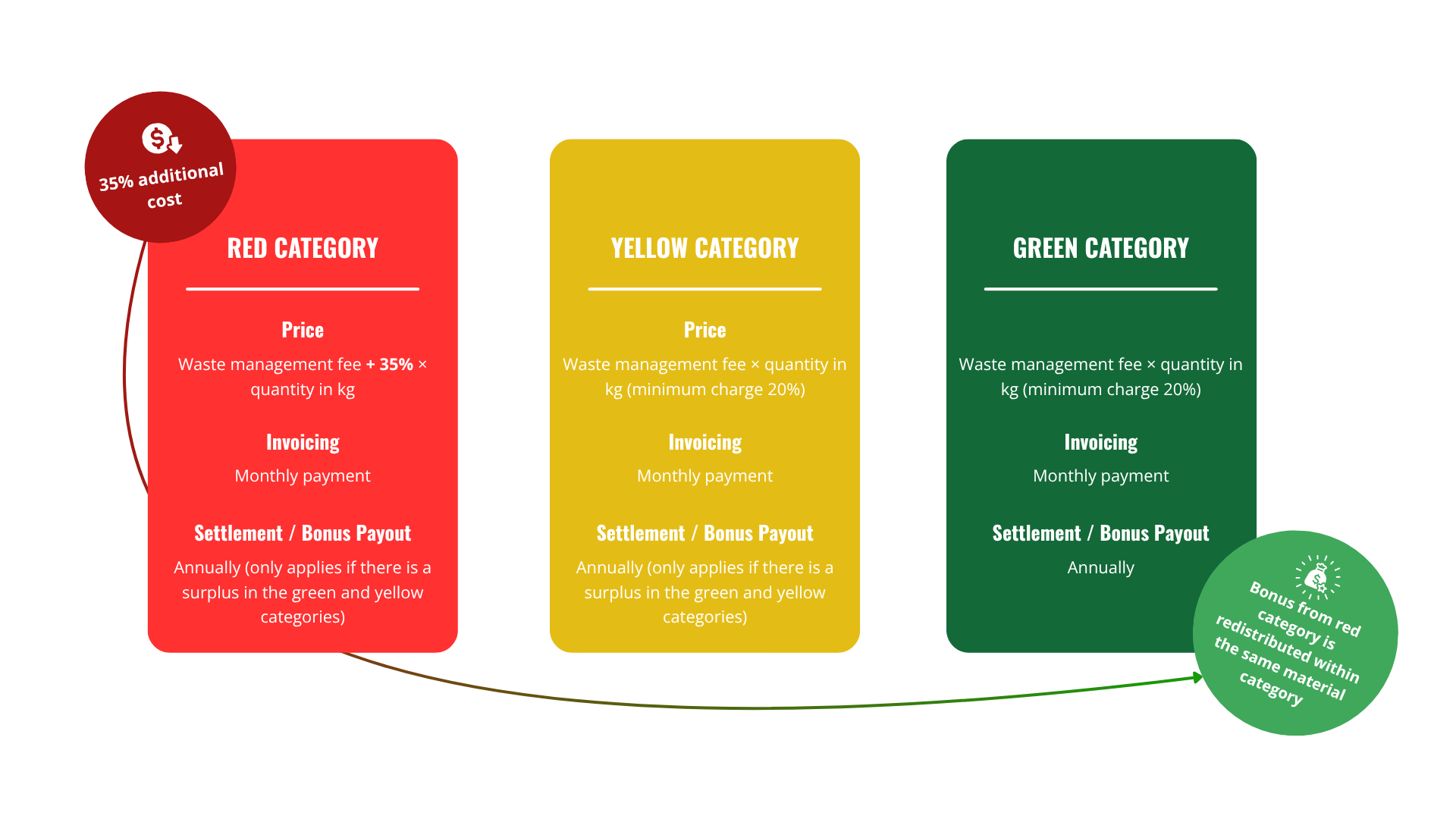
Annual settlement: Once a year, the additional 35% collected for red-level packaging is settled per material category.
Settlement process: Occurs after the annual reporting to DPA, including corrections, re-exported packaging, reporting errors, etc. Deadline: May 31 each year.
Redistribution: Follows the methodology specified by law.
First payout: In Q3 2026 for Oct–Dec 2025.
Packaging is exempt from modulation in the following cases:
Producers placing under 8 tons of packaging on the market per year
Primary packaging as defined in Directive 2001/83/EC, Article 1(23), and Regulation (EU) 2019/6, Article 4(25)
Contact-sensitive packaging for medical devices covered by Regulation (EU) 2017/745
Contact-sensitive packaging for in vitro diagnostic devices under Regulation (EU) 2017
Secondary packaging as defined in Directive 2001/83/EC, Article 1(24), and Regulation (EU) 2019/6, Article 4(26), where required to preserve product quality
Contact-sensitive packaging for infant formula, processed cereal-based baby food, and foods for special medical purposes as defined in Regulation (EU) No 609/2013, Article 1(a)-(c)
It is mandatory for collective schemes to eco-modulate your contributions under the packaging producer responsibility. The model is legally defined in the Packaging Order and consists of two parts;
An economic model that determines how much you must pay based on your reported market volumes.

Producers must cover the operational costs associated with the management of their packaging waste.

The fees charged may not exceed the total operational costs related to the handling and treatment of packaging waste.

Eco-modulated fees reflect how environmentally burdensome a piece of packaging is. The aim is to create a financial incentive for producers to design recyclable packaging, thereby promoting a more circular economy.
The harder the packaging is to recycle—e.g., due to being made of mixed materials—the higher the fee.
Producers choosing low-impact solutions (green level) can have part of their costs covered by the fees paid by producers with red-level (high-impact) packaging.
It is important to note that eco-modulated fees are legal requirements. Collective schemes like Emballageretur are designated to administer the fees – including the modulation – but do not influence the criteria or financial framework.
 Emballageretur